Uncanniness
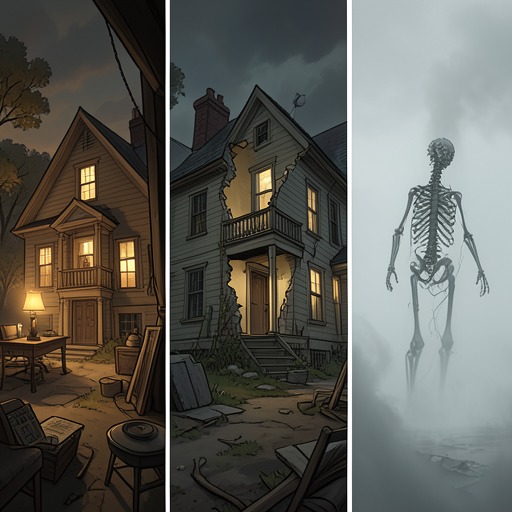
House of LeavesUncanniness names the decisive transformation by which a home ceases to guarantee familiarity, security, or recognizable space. In the Navidson family’s house on Ash Tree Lane, the condition is made concrete by an impossible architectural intrusion: after the family returns from Seattle, a new passage and room exist where photographs prove there had been only a wall. The house remains recognizably domestic while becoming alien, exposed, and untrustworthy; its ordinary appearance therefore intensifies rather than dispels the fear.
Definition and Philosophical Background
Uncanniness is introduced through the German word unheimlich, whose force exceeds a simple synonym for strange. In the Heidegger discussion, anxiety discloses an indefiniteness characterized as “the ‘nothing and nowhere’,” while uncanniness simultaneously means “not—being—at home.” The condition is thus not merely fear of a particular object. It is the breakdown of the background that ordinarily allows a person to feel situated, sheltered, and familiar with the world.
The philosophical account contrasts everyday domestic assurance with the dislocation produced by anxiety. Ordinary familiarity supports an apparently self-evident sense of being at home; anxiety withdraws that assurance and returns existence from absorbed, routine involvement with the world to an existential mode of “not-at-home.” Uncanniness therefore individualizes the person without providing a stable replacement for the lost home. What has failed is not only a building but the confidence that perception and habitation can be taken for granted.
The text also emphasizes the word’s semantic excess. Unheimlich can function adverbially to mean “dreadfully,” “awfully,” “heaps of,” or “an awful lot of.” This association links uncanniness to largeness and overwhelming scale: what is uncanny is too much, too large, or too exposed to remain protective. The house on Ash Tree Lane embodies that extension of meaning because its disturbance is spatially disproportionate to the modest domestic setting in which it appears.
The House as an Uncanny Intrusion
In early June 1990, the Navidsons returned from a four-day wedding trip to Seattle and found that their home had changed enormously. The alteration was not an obvious catastrophe such as fire, robbery, or vandalism. Instead, it constituted an intrusion so abnormal that no one knew how to respond to it. On video, Will Navidson appears almost amused, Karen Green brings both hands to her face as though preparing to pray, and Chad Navidson and Daisy Navidson run through the altered space while playing and giggling, unaware of its deeper implications. The reactions divide the family between tentative disbelief, bodily alarm, and childish nonrecognition.
The newly discovered area appears upstairs in the master bedroom. A plain white door with a glass knob opens not into the children’s room but into a space resembling a walk-in closet. Yet the space has none of the ordinary features that make a closet useful or legible: it lacks outlets, sockets, switches, shelves, a hanging rod, and decorative molding. Its walls are perfectly smooth and almost pure black, with a slight gray quality, and the enclosure measures no more than five feet wide and at most four feet long. At the opposite end, a second identical door opens into the children’s bedroom.
The spatial contradiction is intensified by documentary evidence. Will immediately asks whether the family had somehow overlooked the room, a response that sounds absurd until the event’s perceptual violence is considered. Karen finds photographs clearly showing a bedroom wall without a door. The anomaly therefore attacks not only the house’s geometry but the family’s confidence in memory, vision, and recorded proof. A door is both present and historically absent; a tiny room connects spaces that should not connect; the home becomes a place where evidence confirms impossibility rather than correcting it.
Familiarity, Repetition, and the Unhomely
The later theoretical discussion connects uncanniness to repetition and repression. The unhomely is perceived wherever people are reminded of an inner tendency toward obsessive patterns of action, where the repressed returns through repetition. What seems foreign is consequently not wholly new: it is something familiar and old-established that has been estranged by repression. This formulation makes the house’s corridors and rooms disturbing precisely because they resemble the structures of domestic familiarity while withholding the comfort those structures normally provide.
The house is described as endlessly familiar and endlessly repetitive, filled with hallways, corridors, and rooms recurring over and over. Its emptiness is not neutral. It is characterized as lifeless, objectless, soulless, and godless, a place stripped of the furnishings, books, persons, and symbolic attachments through which a room ordinarily becomes inhabited. The absence of objects turns architecture into an active presence: the blank structure no longer serves human life transparently but confronts the people who enter it.
Its black, smooth walls extend this process of estrangement. The featureless surface resists symbolic interpretation and is presented as a kind of symbol destroyer, a lightless fire that leaves the walls ashen and obsidian-smooth. In this reading, the house becomes a universal eclipse, eradicating what came before and securing independence from inherited meanings at the cost of loneliness, emptiness, and agony. Uncanniness is therefore both an affect and an architectural method: the house makes the familiar unfamiliar by removing the signs that would let familiarity settle into interpretation.
Narrative and Thematic Significance
Uncanniness governs the gap between what the Navidson family sees and what the house can be said to be. The initial change is not presented as a clearly named monster or openly malicious force. It is surprising, unsettling, and disturbing because it remains difficult to classify. The absence of an obvious perpetrator or conventional damage leaves the family facing an intrusion without a suitable response, while the children’s playful movement through it demonstrates how recognition itself can fail to arrive at the same time for everyone.
The concept also gives the book a way to make domestic space carry existential pressure. A house ordinarily promises protection and continuity; here, the same setting destroys security without ceasing to look like a home. Anxiety exposes the instability beneath everyday confidence, and the impossible room turns that philosophical instability into a measurable arrangement of doors, walls, dimensions, and photographs. Uncanniness thus links bodily fear, architectural impossibility, disrupted memory, and the collapse of the distinction between inside and outside.
Finally, the term describes the book’s own relation to knowledge. The reader is asked to remain near an explanation without receiving a reassuring one: the room is plainly documented, yet its existence contradicts the documentary record; the space is minuscule, yet its implications are immense; the house is familiar, yet it becomes “not-at-home.” Uncanniness is the condition that holds these contradictions together. It is the governing experience of a reality that has not become wholly foreign, but has become familiar in the most threatening possible way: altered from within.